We’re constantly bombarded with the idea that our lives should be a relentless sprint. Whether it’s the never-ending honking on Bengaluru’s roads, the intense “hustle culture” gripping Mumbai, or the sheer pressure to “crack” exams in Kota, it feels like we’re always chasing something. We’re hooked on anything “fast”: from our food and internet to our fashion choices and our craving for quick success.
But as we race toward some imagined finish line, it’s easy to lose sight of where we actually are.
That’s where Slow Living steps in. It’s not about being lazy or crawling through life; it’s really about Sanyam, a beautiful Indian principle of restraint and balance. It encourages us to pick quality over quantity, and to truly be present rather than just constantly producing. It’s the simple yet profound art of living better, not faster.
The constant noise surrounding us isn’t just the physical shor of our busy cities; it’s also that digital din buzzing in our pockets. We wake up to a barrage of notifications, and we drift off scrolling through feeds. Our minds often feel like a pressure cooker, constantly hissing and steaming, never quite taken off the heat.
Slow living is essentially a way to dial down that volume. It’s understanding that the world probably won’t stop spinning if you don’t answer that WhatsApp message within thirty seconds. When we intentionally slow down, we finally get a chance to hear the things that truly matter: maybe the gentle rhythm of rain on a tin roof, the quiet breath of a sleeping child, or even just our own inner voice that’s been begging for a moment to just be.
1. Rediscovering Fursat (Leisure)
Think back to our grandparents’ era. Fursat, or leisure, was just a natural part of their day. You’d often find elders sitting on a charpai in the evening, simply watching the sunset or chatting with neighbours, without any particular goal or “agenda.”
Today, many of us carry a subtle guilt if we aren’t constantly “doing” something. If ten minutes open up in our schedule, our first instinct is often to grab our phones and “consume” some content. Slow living invites us to take back those moments of fursat.
Why not give this a try: spend just fifteen minutes each day doing absolutely nothing. No phone, no book, no podcast. Just sit quietly with your tea. Watch the steam rise. Notice the colors of the sky as they shift. This isn’t wasted time at all; think of it more as crucial recharge time.
2. From “Fast Food” to Sukoon ki Roti
One of the most immediate ways we can feel the impact of slow living is right in our kitchens. We’ve become accustomed to ten-minute grocery deliveries and instant noodles, which are undeniably convenient. But in the rush, we’ve often missed out on the real swaad, the true flavour, of the whole cooking process.
Consider the craft involved in making a traditional Dal Makhani or a slow-cooked Sarson da Saag. These dishes take hours, allowing the flavors to slowly develop and blend into something truly soulful. When we choose to cook at a slower pace, we’re doing more than just feeding our bodies; we’re also nourishing our spirits.
Sharing a meal with family, without the constant distraction of a blaring TV, just talking, laughing, and truly savoring every single spice—that, in its purest form, is Sukoon, or peace.
3. Beyond Jugaad: Embracing Mindfulness
We often celebrate Jugaad, that clever quick fix, the hack, the shortcut. While it certainly shows ingenuity, Jugaad can also be a somewhat frantic reaction to a lack of resources or time. Slow living, in contrast, suggests a shift from this constant Jugaad mentality toward Dhyan, or mindfulness.
Instead of always searching for the quickest way to get something done, what if we fully immersed ourselves in the task itself? Whether it’s tending to a garden, spending time painting, or even just washing the dishes, bringing your full attention to it can transform a mundane “chore” into something almost meditative. When you stop rushing just to get to the end, the journey itself truly becomes the most satisfying part.
4. Sustainable Living: Our Ancestors Knew Best
While the “Slow Movement” often gets pegged as a Western trend, for us in India, it feels much more like a return to our very own roots. Our purvaj, our ancestors, lived a life that embodied slow living. They used copper vessels, ate fruits that were in season, wore hand-spun cotton like Khadi, and deeply believed in Aparigraha—non-attachment to things we don’t truly need.
Slow living is, in many ways, a gentle rebellion against today’s “Use and Throw” culture. It’s about making a conscious choice to buy fewer things, but making sure what we do buy is of better quality. It means repairing something when it breaks rather than immediately replacing it, and supporting our local karigars, the artisans, instead of pouring money into huge fast-fashion chains. Ultimately, it’s about understanding that prakriti, nature itself, moves at its own rhythm, and we are an integral part of that larger flow.
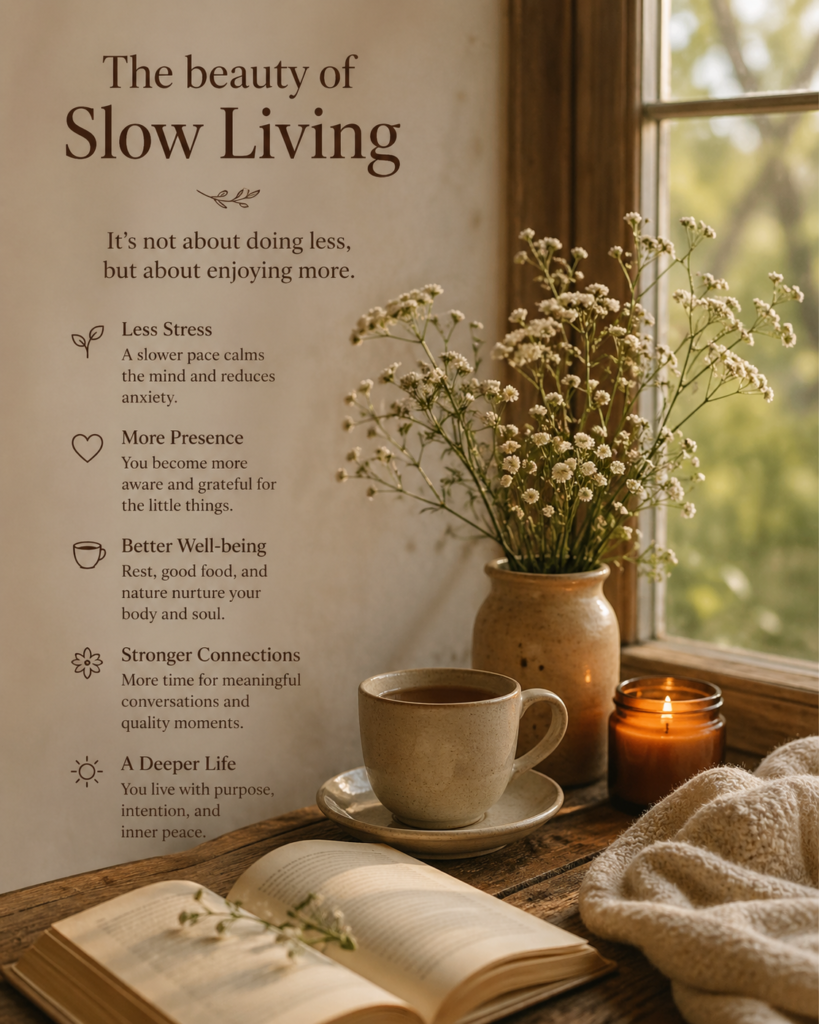
The Logic Behind Moving Slower
If you’re someone who thinks in a very logical way, you might be asking yourself, “But won’t I just fall behind everyone else?”
Actually, it tends to be the complete opposite. When you embrace a slower pace, you’ll often find your clarity of thought significantly increases.
You’ll make better decisions. Without that constant “fight or flight” rush, your prefrontal cortex, the part of your brain that handles smart choices, works much more effectively. This leads to smarter decisions in your career and your relationships.
You’ll feel less stressed. Deliberately slowing down helps reduce your cortisol levels. In a country where lifestyle diseases like diabetes and hypertension are unfortunately on the rise, taking a moment to thoda rukna, can literally be a matter of life and death.
You’ll do deeper work. By focusing intently on just one thing at a time, instead of trying to “multitask” (which, let’s be honest, is largely a myth), actually produce higher-quality work, often in even less time.
How to Begin Your Slow Journey (The Nuskha)
You certainly don’t need to pack up and move to a tranquil mountain in Himachal Pradesh to practice slow living. You can absolutely weave it into your daily life, even in the bustling heart of Delhi or Mumbai.
Try morning rituals instead of morning rushes. For the first thirty minutes after waking up, don’t even glance at your phone. Instead, make your tea, maybe look at a plant, and just breathe.
Consider a digital fast. Pick one day a week, perhaps Sunday, to be completely “offline.” It’s amazing how much this helps your brain declutter itself from all the digital shor of social media.
Learn to say ‘No’ with grace. We often find ourselves saying ‘Yes’ to almost every social invitation, often driven by “Log Kya Kahenge”—that worry about what people will say. Slow living is about gracefully declining things that drain your energy, so you can wholeheartedly say ‘Yes’ to what genuinely fulfills you.
Walk when you can, don’t drive. If the market is just a short distance away, choose to walk. Take a moment to notice the stray dogs, the shopkeepers you pass, the trees around you. Reconnect with your local mohalla, your neighborhood.
The Ultimate Goal: Ananda (Bliss)
At the end of the day, we aren’t just machines designed for maximum output. We are human beings, fundamentally built for connection, for sharing stories, and for experiencing Ananda—true bliss.
Slow living is simply realizing that life isn’t some frantic dash to the finish line. If you run too fast, you might just arrive at the end only to realize you completely missed out on the entire beautiful view along the way.
So, tonight, why not turn off some of those extra lights? Sit down with your family. Take your time eating dinner. Talk about anything and everything, or even nothing at all. Let that feeling of Sukoon truly sink into your bones.
Because life, the real stuff of it, is happening right now: in the quiet pauses between your breaths, in the silences between our words, and in the steady, unhurried beat of a heart that has finally learned to slow down.
Zindagi haseen hai, bas thoda dhere chalke dekhiye (Life is truly beautiful, if you just try walking a bit slower).
Hi Kushagra, truly appreciate your lovely concept to share ideas about leading ‘ sukoon wali life’ amidst the chaos of biz life. Great going.. we will be benefitted to balance the life using the ideas shared by you..